By: Reka Keller, Director of Communications and Marketing
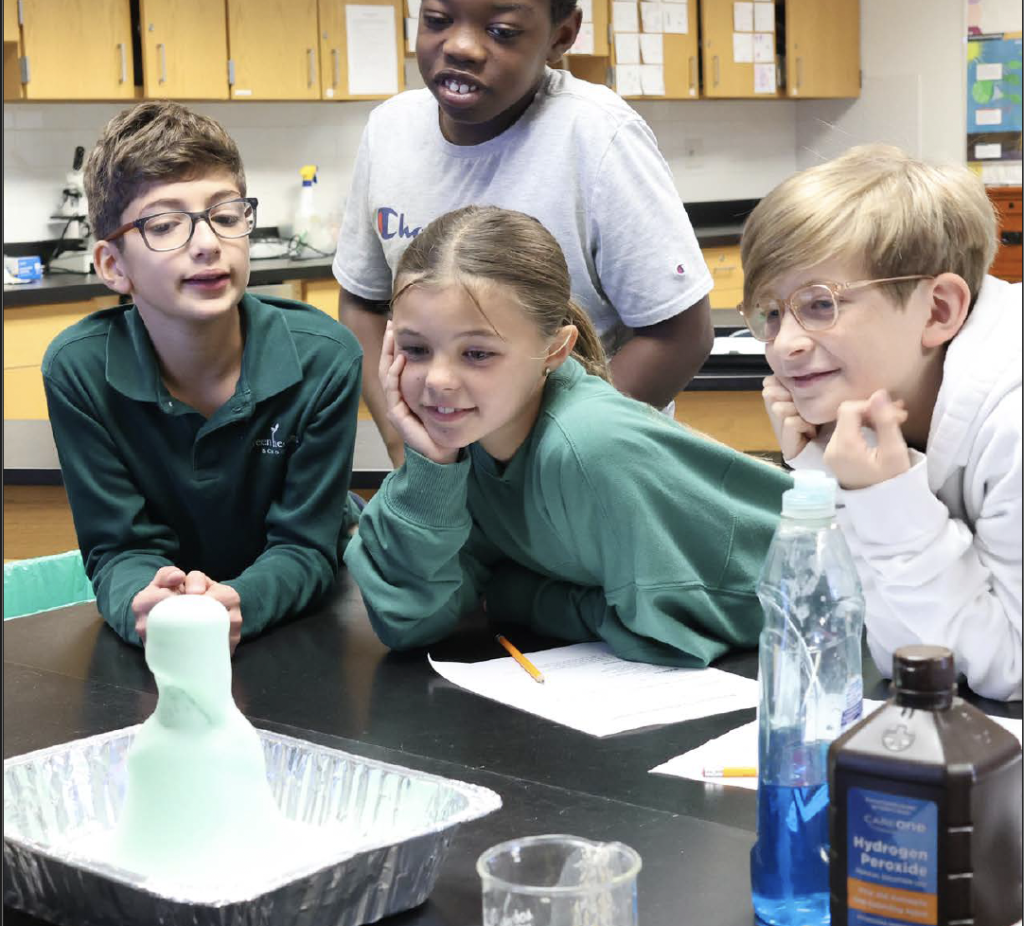
Under the bright lights of the Kilmer Hall Science Lab in Room 7, a group of students is eagerly gathered around a table, staring at a glass beaker filled with liquid. As they examine the bubbling mixture quizzically, they ask Grades 4–8 science teacher Laura Woodcock, “Well, what happens if we add more of the liquid? Will it react by bubbling more or will it stop bubbling?” Questions like these are commonplace for Ms. Woodcock, who joined Green Hedges faculty this year, bringing with her years of teaching experience in the science classroom.
Ms. Woodcock’s passion for science started at a young age and was fueled by experiences such as working for the New England Aquarium in the penguin colony exhibit, performing Mexican Spotted Owl occupancy surveys with the Bird Conservancy of the Great Rockies, and using ArcGIS with the Massachusetts Center for Wildlife and Fishery to track habitat disruptions of raptors. Obviously, Ms. Woodcock is for the birds—meaning extraordinary, of course.
Since stepping into her role, Ms. Woodcock has helped our science curriculum truly take flight. She observes, “Hands-on learning is essential when it comes to chemistry and indoor sciences. But it’s more than just being hands-on—I want students doing physics and chemistry labs, using the equipment we have at Green Hedges, which is extensive! Students need to get their hands on things, know the names, and get outside to explore all the nature on our campus.”
Students have been engaging in these hands-on experiences from the very start of the year. Labs in September introduced them to the various science room materials and equipment so they could become comfortable using them. Grade 7 students examined plants and animal cells under microscopes, noting the differences in cell walls at various magnifications, while Grade 6 students learned to dissect flowers and pinecones and explore their inner workings, and Grades 4 and 5 worked on noting changes both physical and chemical. Grade 8 students, after two-plus years of experience with the materials, completed refresher labs to review natural and artificial materials and learn to split substances before planning, creating, and executing their own experiments comparing natural and artificial substances, such as beet juice versus Red 40 or honey versus corn syrup. These unique opportunities are made possible by small class sizes and teachers who are deeply passionate about their work.
Ms. Woodcock is continuing to expand the exciting initiatives in the science lab with her latest project on bird migration—a topic that, one could say, has really come full circle! This cross-grade, cross-curricular project aims to promote bird conservation as part of Earth Day, incorporating elements from the arts, math, physical education, and science.
The Great Migration project took flight this year with our Grades 6 and 7 students. Early in the fall, alongside their study of binomial nomenclature, each student was assigned a Virginia migratory bird from one of four categories—songbird, raptor, shorebird, or waterfowl. Their birds ranged from the Ruby-Throated Hummingbird to the Northern Shoveler and the Ruddy Turnstone, launching a rich, multidisciplinary investigation into bird behavior, migration patterns, and conservation.
After working with 2D visual references, students began collecting recycled materials to construct 3D models of their birds. While they gathered supplies, they also studied evolutionary changes and natural selection through resources like Darwin’s Finches and hands-on explorations such as a chicken egg dissection. These experiences help prepare them to analyze how their bird’s adaptations have developed over time and how these features support survival in specific habitats.
Ms. Woodcock shared that this project originally began as an Earth Day activity inspired by her own experiences in and beyond college—explaining that she has “always been in the bird realm.” Once the 3D models are complete, Grades 6 and 7 will present them to students in Grades 4 and 5, who have been assigned birds from the same categories. Grades 4 and 5 will then research their birds independently before collaborating with a Grade 1 student to design a costume that represents the species. These costumes may showcase distinctive features such as the long yellow legs of the Greater Yellowlegs or the vivid red eyes of the Canvasback.
In the weeks before Earth Day, students across these grade levels will join together to study the migration routes of their assigned birds. On April 20, families will have the chance to watch as our 3D birds and costumed Grade 1 students “take flight” in a schoolwide migration celebration. Students will share fascinating insights into their birds’ adaptations, diet, nesting habits, and more.
Ms. Woodcock looks forward to Earth Day each year as the culmination of this immersive project, noting that it offers “a natural way for students to examine the world around them and enhance their connection to conservation and the habitats in Virginia.” She also uses this moment to remind our community of simple but meaningful steps we can take to support bird populations: “If you’re using pesticides and herbicides, be conscious of where and how much. Organic landscaping and natural habitats help the birds more than anything else you can do!”
Read more about Green Hedges School in our most recent issue of Clippings