
By: Peter A. Barrett, Interim Head of School
Becoming a daily part of a new school community, especially one with the rich history and the vibrancy of present-day Green Hedges, offers the opportunity for a wonderful adventure. Such has been the case for me during my interim headship, as I regularly learn more about how Green Hedges has become the institution it is today and about the individuals who have animated it over time and continue to do so today. Last month in this space, we examined the role of Green Hedges founders Frances and Kenton Kilmer in working toward equity and social justice at a particularly fraught time in our nation’s history, coinciding with the school’s move from Arlington to Vienna in 1955. I’ll continue to tug at that Kilmer thread this month, all with the intention of concluding, once again, with something important about the Green Hedges they founded in 1942.
I’ll start by observing that Frances and Kenton Kilmer had children—and by today’s standards, lots of children, reaching ten in 1958—and raised them in what we know today as Kilmer House after the school relocated to Vienna. It was a determination to provide their own children with the kind of education they thought all children should have that led the Kilmers to create Green Hedges School. Not surprisingly, they cultivated in their children a love of learning, curiosity, a sense of wonder, and a delight in language, literacy, music, and the arts, just as they hoped to do with others’ children.
One writer whose novels the Kilmer children particularly loved was C.S. Lewis (1898-1963), the author of The Chronicles of Narnia and other works, including fairy tales, science fiction, Christian theology, and literary criticism. Readers, many of them children, often wrote to Lewis to thank him for his books, to ask questions, and to share what his books had meant to them. And Lewis, in turn, took on the task of responding personally to each one from his college or home in Oxford, England, including children more frequently following the 1950 publication of the first of his Narnia books, The Lion, the Witch, and the Wardrobe.
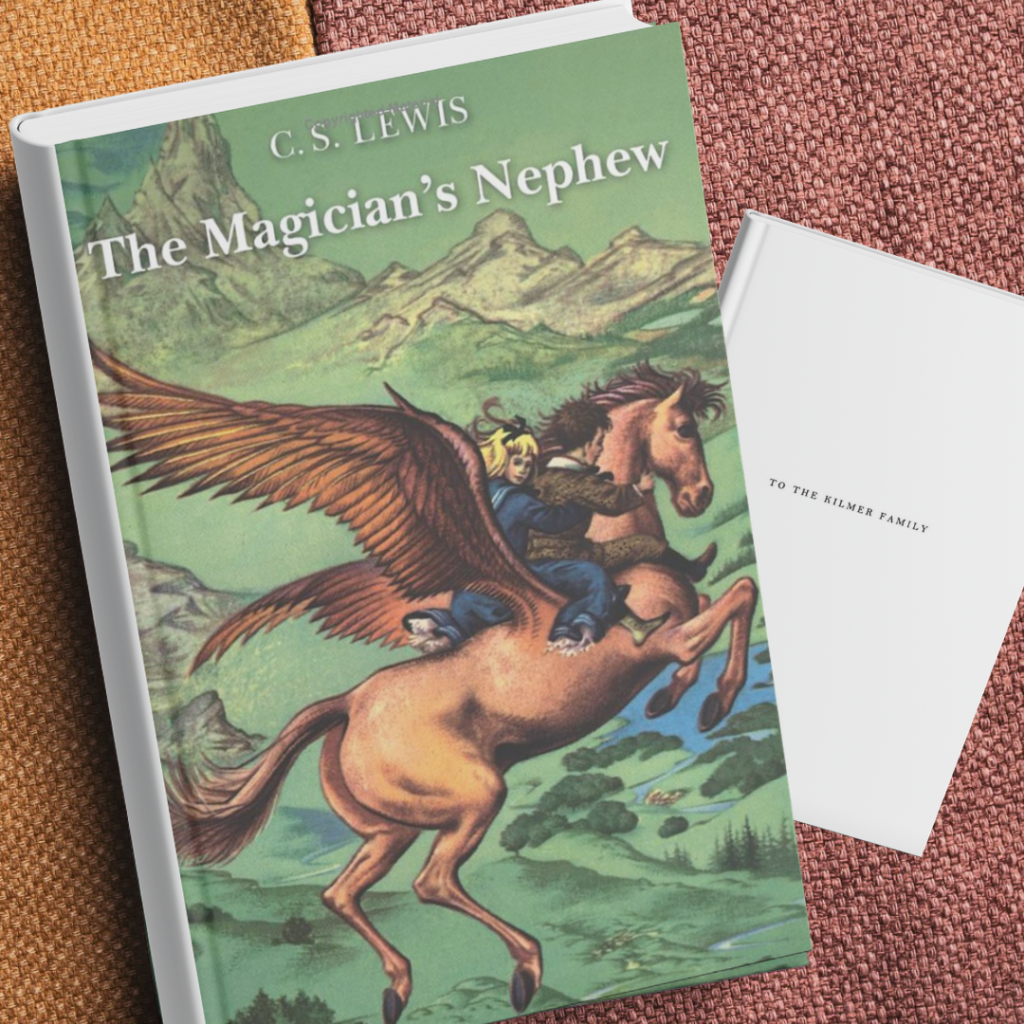
Perhaps you see where this account is headed: The Kilmer children, encouraged by a family friend, corresponded frequently with Lewis, sharing their own delight in and questions about his books, some of their own stories and artwork, and their accounts of life along Windover Avenue. Many of those letters appear in the 1985 collection C.S. Lewis Letters to Children, edited by Lyle W. Dorsett and Marjorie Lamp Mead. Furthermore, the sixth book in the Chronicles of Narnia, The Magician’s Nephew, is dedicated to the Kilmer family. In a January 1954 letter to the children, Lewis wrote, “You are a fine big family! I sh[oul]d. think your mother sometimes feels like the Old-Woman-who-lived-in-a-Shoe (you know that rhyme!). I’m so glad you like the books.”
In a July 1955 letter to Hugh Kilmer, Lewis wrote, “I am delighted to hear that you approve of The M[agician]’s N[ephew]; it would have been awkward if the one dedicated to you had turned out to be just the one of the whole series that you couldn’t stand!” That letter continues, on another note, “I am thrilled to hear that your street runs North as well as South, because in this country, all streets (and even country roads) run two directions at the same time. They are trained to change the moment you turn around.” I wonder if Hugh’s June 14 letter (the collection includes only Lewis’s replies) had commented on any oddities with respect to the directionality of Windover Avenue.
While Lewis’s responses to his many young correspondents are a particular delight, I would like to pivot to the editors’ introduction to the collection to make another, hopefully related, point. “The author believed that answering these letters was a God-given duty,” they observed, “and his replies reflect the concern and care that he brought to the task.” Noting that he was intent on treating young people with respect, they quote Lewis himself: “Once in a hotel dining-room I said, rather too loudly, ‘I loathe prunes.’ ‘So do I,’ came an unexpected six-year-old voice from another table. Neither of us thought it funny. We both knew that prunes are far too nasty to be funny. That is the proper meeting between man and child as independent personalities.”
Treating children with concern and care, with respect, and recognizing them as “independent personalities” seems a wonderful way to begin and to sustain our work with young people, regarding them with the seriousness they deserve. At the same time, it is clear from Lewis’s July 1955 letter to Hugh that such a seriousness of purpose leaves plenty of room for playfulness, for curiosity and wonder. The Green Hedges I have come to know treats young people with that concern and care, with that respect, even as we invite them into the play of the imagination, of curiosity and wonder. It needn’t be a balancing act or an instance where we need to pick and choose. Instead, if we recognize these “independent personalities” in all of their emerging fullness, we can set them (and us) on an exciting journey. I am pleased to be on that journey with all of you.